
.
The Tartan Army has left Boston for Miami and New England is a sadder place for it.
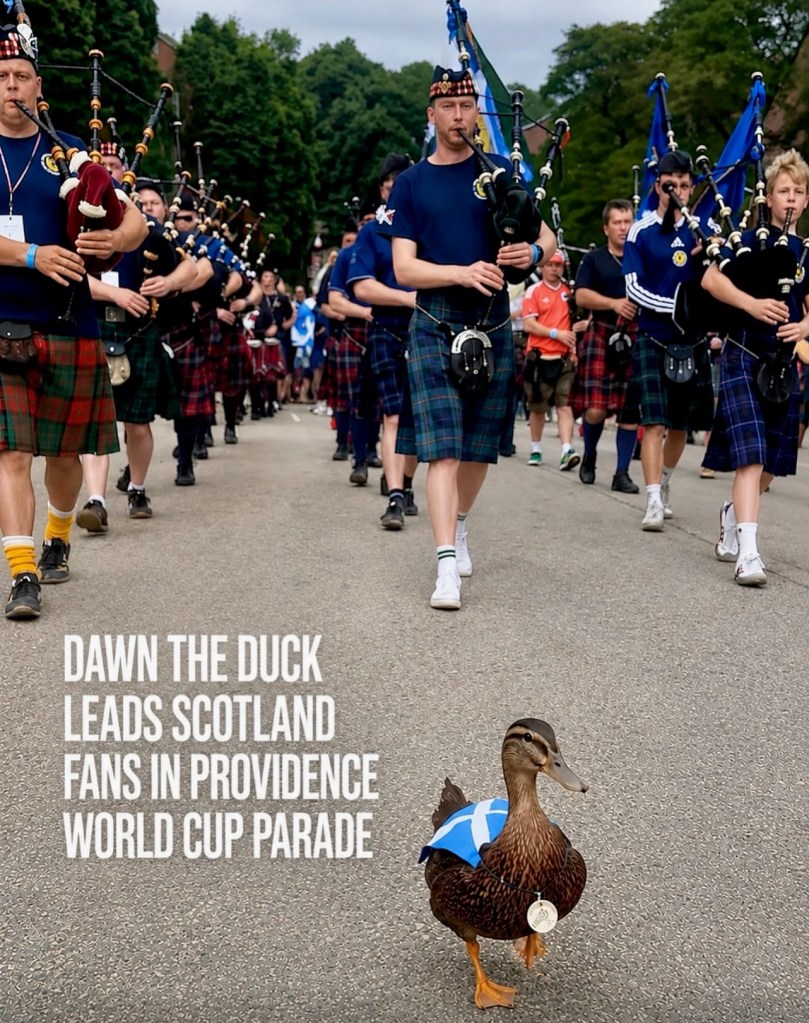
Providence Rhode Island rolled out the welcome mat and found thousands of accommodations for the group while they were watching the World Cup. The Army said thank you with $30,000 in charitable donations… and a parade.
.
.
I love these people.
.
.
The United States has been a stressful place to live lately. Filled with distrust, division and disrespect. But for a little while this joyous group of Scots lifted American spirits with their goodwill and comical antics.
,

.
Amen to that.
I found the following on Facebook. It’s a long read, but says it way better than I can….
.
“Somewhere in Boston, a bartender is standing in front of an empty beer tap, a park maintenance man is enjoying the easiest cleanup of his career, and a bronze patriot on a horse is wearing a traffic cone like he just pledged a very rowdy fraternity.
Which could only mean one thing:
The Scots showed up for the World Cup
The Tartan Army, that glorious, singing, beer-drinking, flag-waving, kilt-adjacent force of nature, descended upon Boston for the World Cup to cheer on Scotland, and by all accounts, the city was not spiritually, emotionally, or commercially prepared.
They literally drunk the town dry. Bars ran out of lagers all across town. Suppliers couldn’t keep up with the demand. Bar owners danced like it was Christmas.
Now, I do not mean that as criticism. I mean that as a public safety bulletin.
Boston has survived a lot. It has endured revolutions, blizzards, Red Sox heartbreak, roundabouts, and people from away trying to pronounce “Worcester.” But I am not sure any city can fully prepare for thousands of Scottish soccer fans arriving with open hearts, strong livers, and a working knowledge of public statuary.
Because this is not just fandom. This is cultural export.
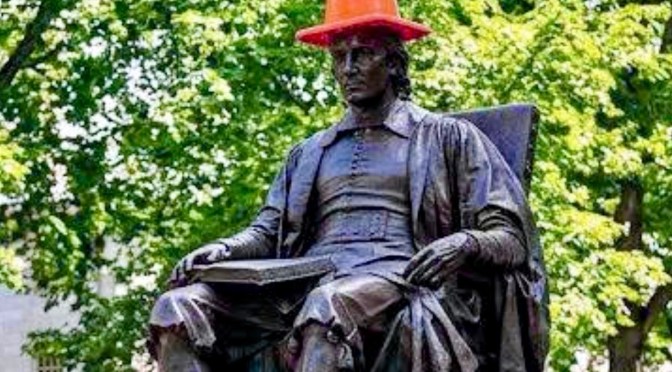
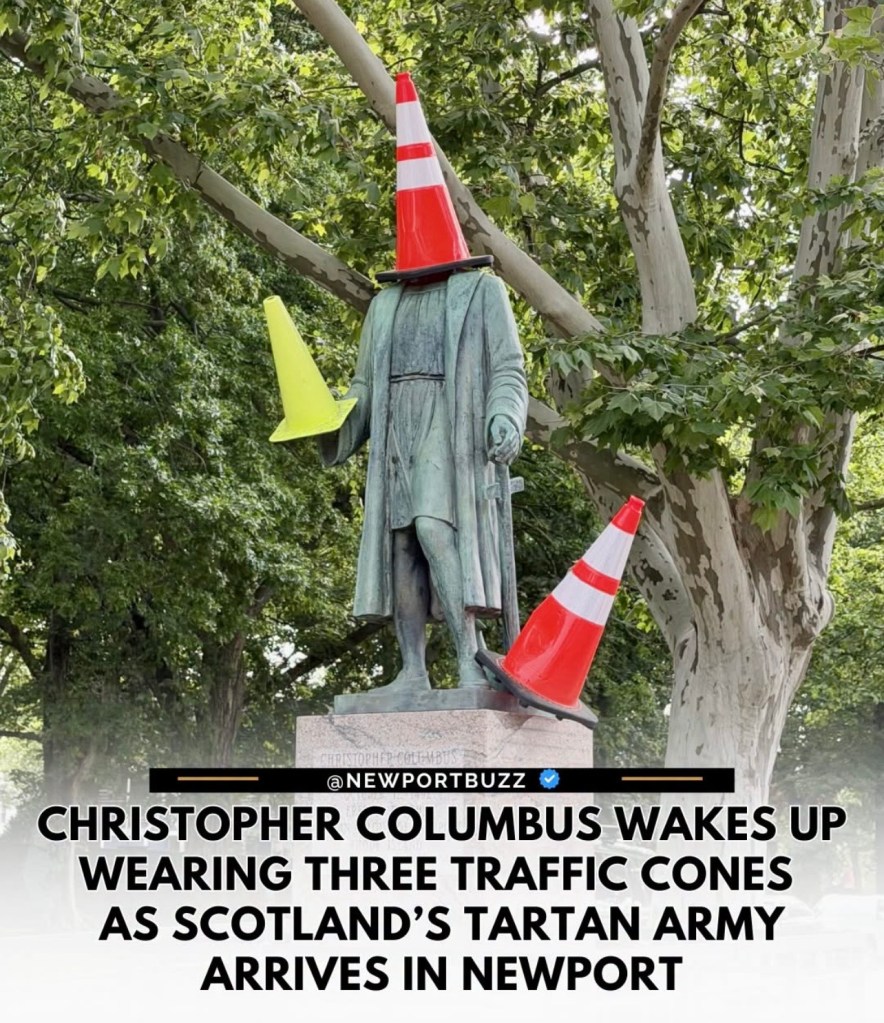
You see, Dear Readers, the Scots brought more than thirst, they brought songs, scarves, and the sort of national pride that makes you misty-eyed even if you do not know the second verse. They also brought one of Scotland’s most sacred modern traditions: placing traffic cones on the heads of statues.
Which may be my favorite thing ever.
For those unfamiliar, putting a cone on a statue is not mere mischief. It is art. It is protest. It is comedy. It is “bless your heart” rendered in municipal plastic.
The tradition took root in Glasgow in the 1980s, when late-night pranksters, students, naturally, because education comes in many forms, began crowning the Duke of Wellington statue outside the Gallery of Modern Art with a traffic cone. Authorities removed it. Citizens replaced it. Authorities removed it again. Citizens replaced it again.
At some point, Glasgow gave up pretending the cone was a problem and accepted the truth: that statue belonged to the people, and the people had spoken.
They wanted the Duke in a hat.
There is something so perfectly Scottish about that. Not mean. Not destructive. Just dry, stubborn, hilarious defiance. A wink at authority. A little civic rebellion with no casualties except dignity.
And now, apparently, Boston’s statues have been welcomed into the fellowship.
Imagine being some stern bronze historical figure, standing there for generations in noble silence, when suddenly a band of Scottish fans wanders by at midnight and decides, “Aye, he needs a cone.”
And they are right. He does.
Every statue looks better with a traffic cone. That is just science with an accent.
There is Paul Revere, warning the colonists and now also warning pedestrians about roadwork. There is some deeply serious founding father looking like he just lost a bet at a pub quiz. There is a horse, probably wondering what in the name of oats is happening.
Boston, in that moment, did not get vandalized.
Boston got accessorized.
Now, I say all this with my whole heart because my love for Scotland is not casual. It is unreasonable. It is emotional. It is the kind of love that makes me look at misty hills and ancient stone walls and feel like I left part of myself there in another life. I love Scotland’s beauty, yes, but I especially love its spirit… tender and tough, poetic and profane, deeply proud and deeply funny.
Scotland can break your heart with a ballad, then make you snort-laugh five minutes later with a joke delivered so dry it needs a weather advisory.
That is the magic.
And apparently, the Tartan Army carries that magic wherever it goes.
They do not just attend a match. They become a weather event. They sing in the streets. They befriend strangers. They turn pubs into embassies. They make a sidewalk feel like a family reunion where everybody is somebody’s cousin, and nobody is entirely sure who brought the cooler.
Down South, we understand this kind of gathering.
We know tailgates. We know porch music. We know the sacred geometry of folding chairs around a cooler. We know that once a group of joyful people gets properly assembled, somebody is going to start singing, somebody is going to cry about their grandmother, and somebody is going to climb something they had no business climbing.
So yes, I feel some kinship with the Scots. I understand the singing. I understand the thirst. I understand the flag-waving. I even understand the spiritual necessity of placing a traffic cone on a statue and saying, “There. Fixed it.”
But here is the part that really got me.
After one especially rambunctious gathering of Scottish fans at a Boston park, the kind of party that likely involved chanting, dancing, emotional declarations, and at least three men promising to name their next child after a striker, the maintenance guy showed up the next morning to clean the venue.
He was the only one assigned.
One man. One park. The morning after one night after the Tartan Army.
You can picture him, can’t you? Walking in at sunrise with gloves, trash bags, and the weary expression of a man who has seen what humans can do when sports and beer get married under a full moon.
He probably expected chaos. Cups everywhere. Food wrappers blowing like tumbleweeds. A level of mess requiring both a leaf blower and prayer.
But no.
The place was immaculate. He said it did not take much cleaning at all because the Scots had left it spotless.
Now, there’s nothing like raising a little hell without forgetting your manners, it’s like fully enjoying a good party even though your mama is watching from heaven, and she knows your full government name.
They may have emptied every keg from Back Bay to Beacon Hill. They may have sung loud enough to wake Sam Adams. They may have crowned the vast majority of the city’s statues with orange traffic cones like Boston had suddenly joined a very festive construction project.
But they cleaned up after themselves. That’s character. That is the difference between a nuisance and a legend.
The Tartan Army did not just come to Boston to cheer for Scotland. They came to remind us that joy can be wild without being careless. That rebellion can be funny without being cruel. That you can love your country loudly, drink a city dry, decorate its statues with road safety equipment, and still leave the park cleaner than you found it.
Lord, I love these people.
I love their songs. I love their stubbornness. I love their ability to make civic officials sigh deeply while tourists take pictures. I love that somewhere in Boston, a maintenance man expected disaster and found decency instead.
And I love that Scotland, even far from home, remains unmistakably Scotland: A little rowdy. A little reverent. A little rebellious. A little cone on top of the establishment.
So here is my call to action, friends: raise a glass to the Tartan Army, assuming there is anything left to pour, hug a Scottish fan, learn a song, take a picture of a cone-topped statue, and when the party is over, pick up your trash.
Because the Scots have shown us the way:
Drink the town dry if you must.
Cone the statues if you can.
…and for the love of St. Andrew’s Cross, leave a place better than you found it.”
❤️
I think we could all use a little Scotland in our lives right now.
.
.
That being said…
Does anyone know where I can buy a traffic cone?
.
 River's world.....